
Logan State Release Paths
The state route should always remain tied to Logan’s detention page, county sitemap, and local court office when custody began in the county.
Kentucky Department of Corrections, or KDOC, manages state correctional custody and community supervision. Its public records can cover people held in an institution, a county jail under a state classification, Home Incarceration Program, Interstate Compact, or a probation and parole district. Logan County Detention Center houses a mixed local and state population, so the building alone does not decide which database applies. Confirm that the person had a DOC or PID number before treating a county departure as a KDOC event.
A state prisoner may discharge at minimum expiration, begin discretionary parole, enter mandatory reentry supervision, start shock probation, move to conditional discharge, enter home incarceration, transfer, or leave subject to a detainer. These terms carry distinct legal consequences. “Minimum/Detainer” signals a need to find another custodian. A probation or parole office as current location reflects community supervision. It is not the same as a final discharge.
Confirm Logan State Releases
Start at Kentucky Offender Online Lookup, known as KOOL. Search with surname and first name, then narrow by DOC or PID number, county of supervision, location type, or supervision status. Over-filtering can hide the correct person. Open the full profile and record the system-specific identifier, current location, supervision status, and any projected date. A prison or county jail is current custody. HIP remains correctional control. A district office means the person is in the community under supervision.
- Match identity with the DOC or PID number plus another identifier.
- Read KOOL’s Current Location literally.
- Open the correct date in KDOC Daily Releases.
- Search the PDF by surname or DOC number.
- Save the exact Type of Release and Released From fields.
- Check the court, jail record, or receiving custodian if a detainer or conflict appears.
The Daily Releases report is the stronger source for an actual state event. KOOL is the stronger public source for the state’s currently displayed profile. If they disagree, consider daily update timing and KDOC’s warning that information newer than 120 days may not be finalized. Request the underlying record instead of silently choosing one date.
KDOC Daily Releases for Logan
Kentucky publishes date-labeled PDFs rather than a rolling Logan County 24-hour or 72-hour feed. Reports list DOC number, name, release type, releasing facility, and felony class. Prior releases are linked through an archive. Search every relevant date when the window crosses midnight or a weekend. The report includes state-classified releases, not every local detainee who bonded out or completed a short county sentence.
A historical report includes a shock-probation release from Logan County Jail. That detail confirms that “Released From” can name a county facility even though the event belongs to KDOC. Preserve the state’s wording. “Discharged-Minimum Expiration” differs from “Mandatory Reentry Supervision-In State.” “Shock Probation Began” reflects a court change after incarceration started. “Minimum/Detainer” does not establish community freedom.
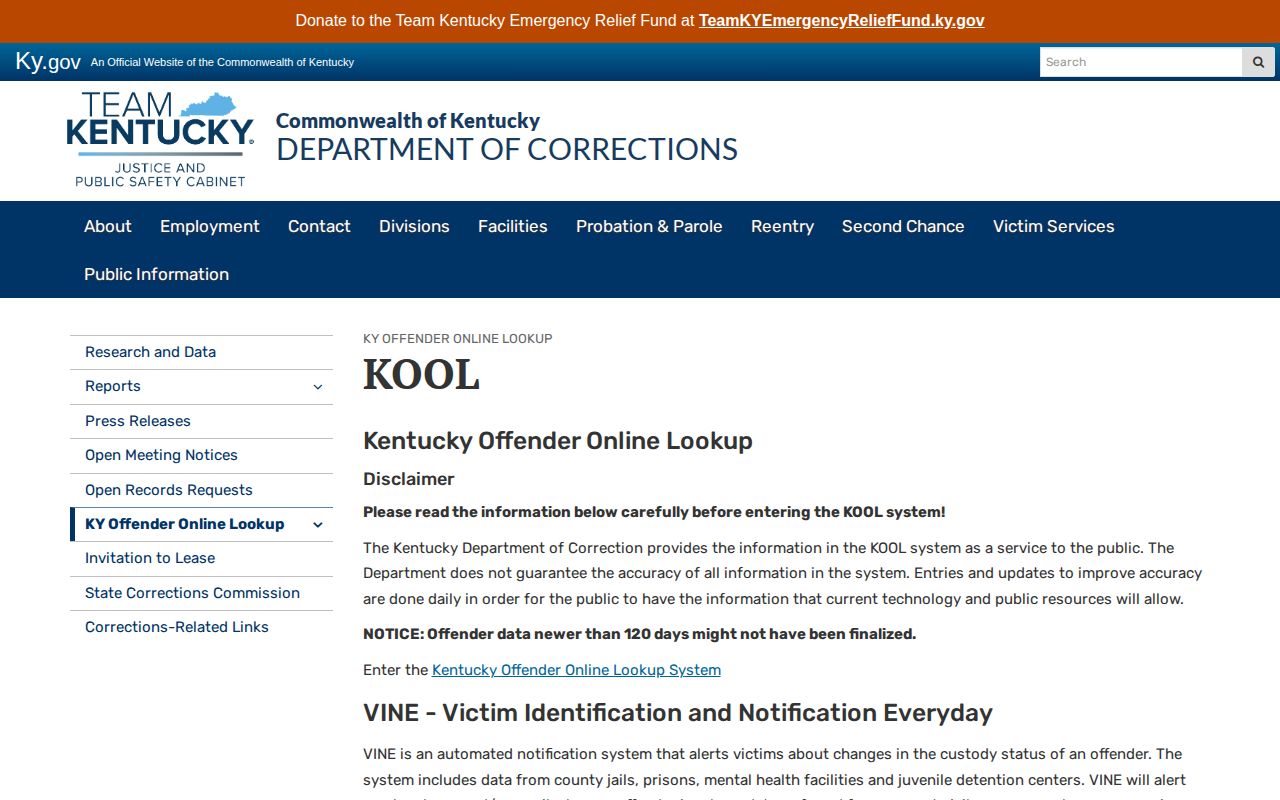
The official KOOL information page explains the daily update and finalization caution. The screenshot below comes from that source. It helps readers understand why a very recent profile may change after review.
Projected Dates Are Not Releases
KOOL advanced search uses the exact labels “Projected Release Date From” and “Projected Release Date To.” Those fields help define a date range. They do not prove that a person departed. Kentucky sentence credits, forfeiture, recalculation, treatment rules, court action, parole action, detainers, and consecutive sentence aggregation can change what happens. A court order date can also precede physical release processing.
Use Inmate Release Date for the full projection workflow. For past events, prefer a dated state report, VINE event, or final agency record. Label each date by source and type. A projected date, court-order date, VINE event date, and jail departure time can all answer different questions without one being a typographical error.
A future projection should never be rewritten in the past tense merely because its calendar day arrived. Search that date’s release report and the days around it, then inspect the current location. Credits or detainers may have altered the result. If the state report does not contain the person, request the final record instead of treating the projection as an undocumented release.
Logan Supervision After Release
Logan County is served by KDOC Probation and Parole District 2 in the Western Region. The Logan satellite office is at 253-A Hopkinsville Road, Russellville, KY 42276. Its published telephone numbers are 270-726-6530 and 270-726-4987. The District 2 main office is at 512 South Clay Street, Hopkinsville, KY 42240, telephone 270-889-6530.
After KOOL displays a district or supervision office, use that office for public verification and instructions. A phone refusal or inability to disclose details does not prove that supervision ended. Documentary proof may require an existing KDOC record. “ABSCONDED” marks an unresolved supervision issue, not successful completion. Parole / Probation separates parole, probation, shock probation, mandatory reentry supervision, and final discharge.
KDOC Release Records and Images
KDOC accepts open-record requests through its published process. Identify the person by full name, date of birth, and DOC or PID number. Ask for the existing final release or discharge record, recorded release date, exact type, Released From facility, and most recent releasable offender identification photograph. Electronic copies are preferable when available. KDOC applies its own response process and may charge under Kentucky law.
Most, not all, KOOL profiles include a photograph. A camera indicator signals availability. KDOC says institutional images are updated at least annually or after a significant appearance change. That image is a state offender-identification photo, not automatically a Logan County booking photo. The distinction matters when matching records from different custody periods.
Different dates can all be accurate because they describe different acts. A court order records what the judge authorized. The Logan jail entry records local departure. A Daily Releases report records KDOC’s event. KOOL records the profile displayed at search time. VINE records a notification event. Keep the source name beside each date rather than reducing them to one generic field. When “Released From” names Logan County Jail, check KOOL for the next state location or supervision status. If a detainer appears, search the receiving custodian.
Local and State Records Compared
| Question | Best source |
|---|---|
| Is the person in Logan jail now? | Official current-inmate roster |
| Did KDOC record a release? | Dated Daily Releases PDF |
| What state status appears now? | KOOL profile |
| What did the judge order? | Logan court file |
| When did Logan process departure? | Jailer release entry |
A local-only detainee can leave Logan County Detention Center without appearing in KOOL or Daily Releases. Conversely, a KDOC prisoner can be released from a county bed and appear in both state sources. The full Logan County released inmate lookup routes each custody class without treating a no-result as proof.
Read Kentucky Release Language Precisely
Kentucky’s release vocabulary should remain intact in notes and requests. “Mandatory Reentry Supervision-In State” describes supervised release and is not final sentence completion. “Shock Probation Began” points to a court decision that changed how the sentence was served. “Discharged-Minimum Expiration” is stronger evidence that the named state term ended, while “Minimum/Detainer” signals another-custody review. A transfer ends custody at one location but not KDOC control.
Current Location adds the next layer. A named institution or county jail means custody. Home Incarceration Program remains a correctional status. A probation and parole district indicates community supervision. Interstate Compact can connect supervision to another jurisdiction. “ABSCONDED” describes an unresolved enforcement status, not release from supervision. Copy the displayed term before adding a plain-language explanation.
A Daily Releases match should be saved with its report date and DOC number. Do not search only by a common surname. Record Type of Release and Released From together. A Logan County Jail value in Released From is a strong local connection, but it does not state the destination. KOOL, the jail entry, or another receiving record must answer that question.
Correct a Kentucky Release Record
Direct a disputed KOOL or Daily Releases item to KDOC’s public-information or open-record channel. State the exact field, DOC or PID number, source URL, report date, and reason it appears inconsistent. Attach the saved record when permitted. A court-order problem belongs with the clerk, and a Logan jail departure problem belongs with the detention center. Each office can address only the record it maintains.
If a correction changes the public profile, preserve the response with the earlier result. Kentucky’s 120-day warning means a recent field can be revised during finalization. That warning supports verification; it does not make every recent result useless. The dated state report, current profile, court order, and agency response together provide a clearer chronology.